Beat ’em ups are a tricky balancing act. On the one hand, they are a power fantasy; the virtual replica of Old Boy’s corridor scene or Snowpiercer’s push toward the Engine: a seemingly hopeless run of vindictive violence. On the other hand, their brutality is monotonous. Beyond transitions to the third dimension, the genre has seen little experimentation. Their essence is an exercise in pressing the same two buttons over and over again while going straight. Empowering, but dull. Effective, but simple.
Perhaps more so than any other genre, beat ’em ups benefit from the multiplayer bias. Any experience, even when tedious at its core, becomes more enjoyable when frantically experienced with friends. Throw in a known license, like The Simpsons, Teenage Mutant Ninja Turtles or The Avengers, and you are bound to derive some pleasure. As a singular affair, however, their longevity has, on average, always been lacking.
Capcom’s efforts might have been most transformative for the genre’s evolution. The studio’s work, Tower of Doom (1993) and Shadow over Mystara (1996), adapted the Dungeons and Dragons license into a unique blend between belt scroller and action-RPG. In incorporating player progression, Capcom helped overcome the formula’s tedium and, in so doing, strengthened the genre’s potential as a single-player experience. Treasure’s Guardian Heroes and Atlus’ Princess Crown count as early – though not commercially successful – adopters of this combination for the home consoles. Unsurprisingly, the latter’s director, George Kamitani, was credited as dungeon master on Tower of Doom.
Kamitani would later co-found Vanillaware and direct the spiritual successor to Princess Crown, Odin Sphere. Odin Sphere still stands as a pinnacle in the genre. Whereas Vanillaware’s mastery of the 2D plane remained unsurpassed, Sega’s Yakuza series would bring Capcom’s blend into 3D. Others would stick more closely to the genre’s roots, such as Rockstar’s The Warriors or Guard Crush Games, DotEmu and Lizardcube’s 2020 revival of the Streets of Rage franchise.
In 2025’s Absolum, Guard Crush Games and DotEmu build upon Streets of Rage 4’s solid foundations to further the beat ‘em up’s growth. Paradoxically, their success leverages the structure of another genre rooted in repetition: the rogue-lite. In adding randomisation, Absolum softens the monotonous aspects of the genre, while leaning into its strengths.
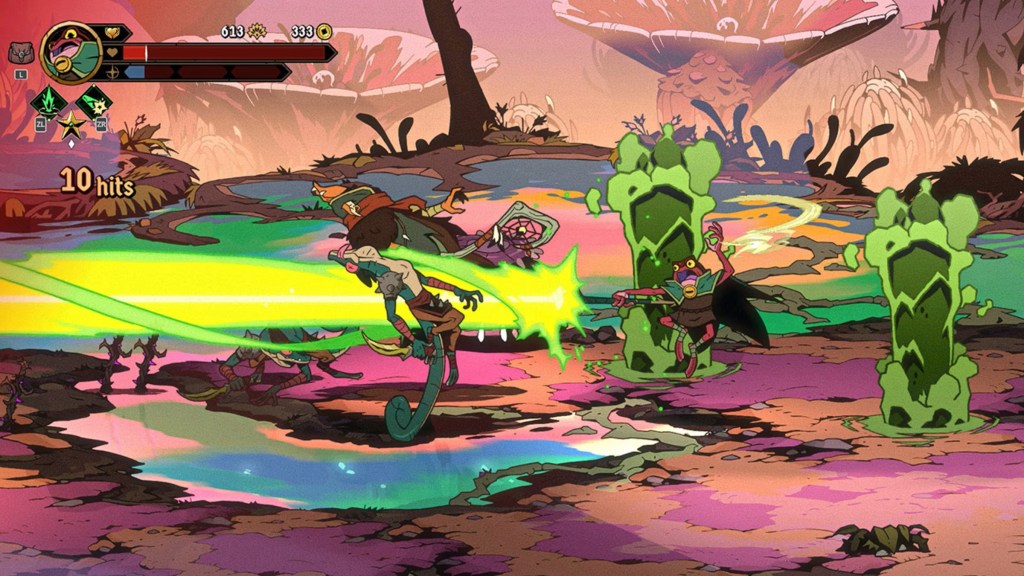
Those strengths are the genre’s mechanical foundations. Players have access to an arsenal of light, heavy and magic attacks, dodges and parries. The only thing missing from turning this into an actual fighting game is joystick combos and links. Moreover, the translation from the player’s input to their character’s output and its subsequent connection to the enemy’s hit box in visual and sound design feels weighty. Whereas the physicality of the game’s underlying core mechanics keeps combat satisfying, the broad move set facilitates diversity. The latter is expanded by an instance-based player progression system where randomised elements, like relics and elemental upgrades, influence your character’s output that runs onwards. Isolated successes can be converted into permanent improvements for subsequent runs. Combat and movement, therefore, remain rewarding even upon repeat play. Adding to the game’s longevity is Supamonk’s cell-shaded, Franco-Belgian comic-book style visualisation. Absolum is going straight worth looping.
And if that does not convince you, you can play this game as a toad wizard with a wall bounce magic attack reminiscent of Urien’s Aegis Reflector in Street Fighter III: 3rd Strike.
 Coded Mass
Leave a comment